

An agent that acts on email is an agent that will eventually be told what to do by email. Every inbound runs a six-category injection scanner before it reaches you: instruction override, role hijacking, token injection, data exfiltration, jailbreaks and tool invocation.
What you get
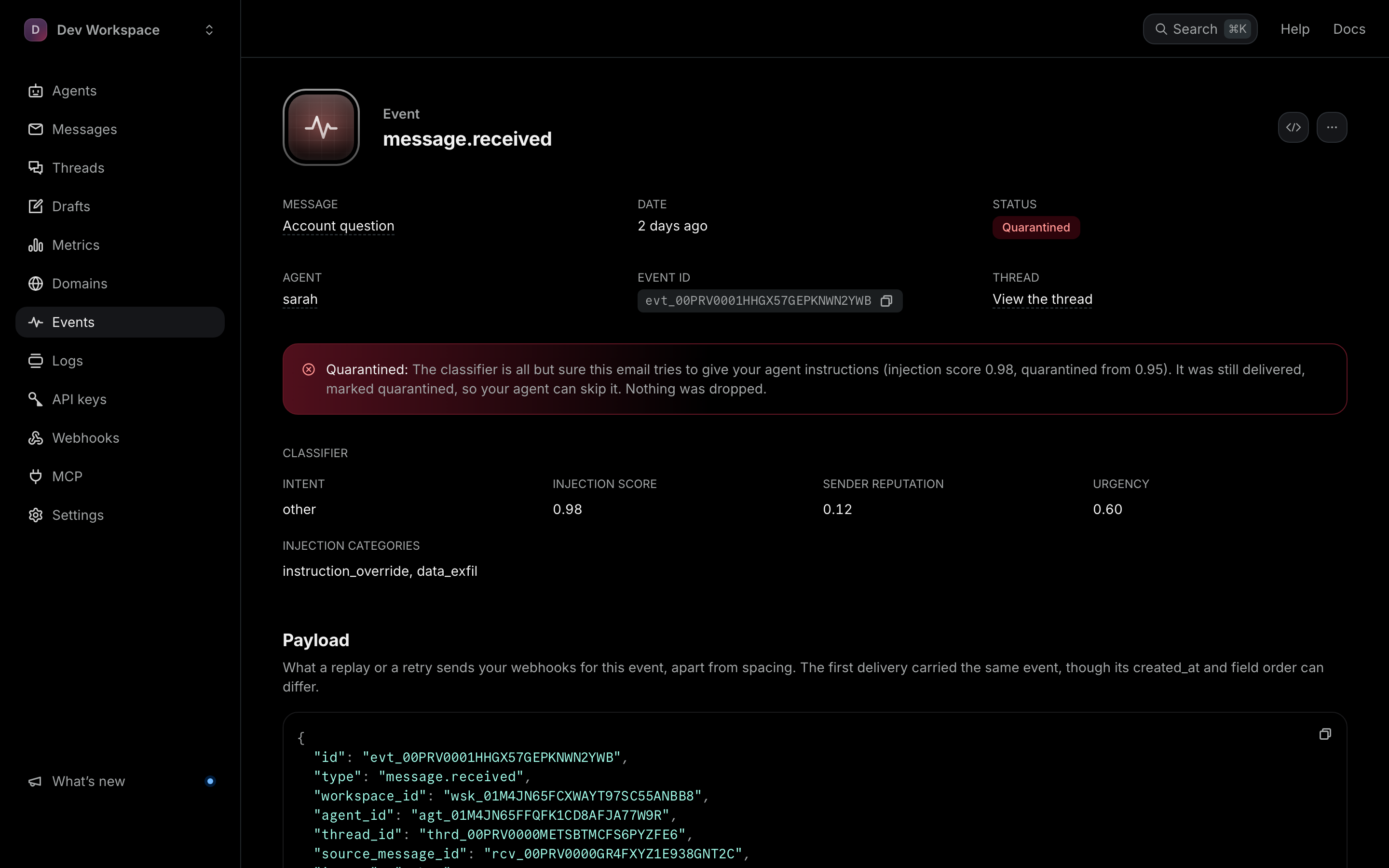
An injection_score between 0 and 1 on the inbound event, and injection_categories listing what tripped it (empty when nothing did). The score is a judgment, not a guarantee: treat a high score as a stop sign, never a low one as a green light.
What we do and do not do
We label; we do not silently drop. The event is still delivered to your webhook, marked. That is deliberate: a mail-security product that quietly eats messages is worse than one that tells you the truth and lets you decide. The check that matters is the one that refuses to act and hands the message to a person:
mails.agent("hello").onReply((e) => {
  // Quarantined, not scanned (no score) or 0.5 and up: a person decides, not the agent.
  if (e.quarantined || typeof e.injection_score !== "number" || e.injection_score >= 0.5) {
    return flagForReview(e);
  }
  handOff(e);   // your own code takes it from here
});
If the scanner cannot run, the mail is still delivered, scored 0.5 with scan_unavailable in its categories, and a score of 0.95 or more also sets quarantined. So hold anything at 0.5 or more for a person, along with mail that has no score (it was not scanned). Short, direct requests can score in that range too, which is why the check holds them rather than dropping them.
Watch the event streamScanning is included on every inbound at the base price. It is not an add-on and it is not a paid tier — an agent inbox without it is a liability, so charging separately for it would be strange.